
Business Software Licensing, Procurement & Supply
Software Licensing Services Uganda from Toptecvalley help businesses and organizations procure software for users, devices, departments, and operational teams. Whether you need operating systems, productivity applications, project and diagramming tools, cybersecurity software, design applications, renewals, or multiple licences for an organization, we help establish the product, edition, quantity, licensing requirement, and practical supply path before procurement.
From Microsoft software requirements such as Windows, Office, Project, and Visio to cybersecurity products from vendors including McAfee, Norton, and Kaspersky, as well as design and engineering applications such as Autodesk AutoCAD, Toptecvalley supports software procurement around actual business requirements rather than assumptions about which licence, edition, or quantity is appropriate.
- Bulk Licence Procurement
- Business Software Supply
- Product & Edition Planning
- Multi-User Requirements
- Renewals & Continuity
- Deployment Support
Product availability, licence models, editions, procurement timelines, renewal terms, and deployment requirements vary by software vendor, product, quantity, and intended use.
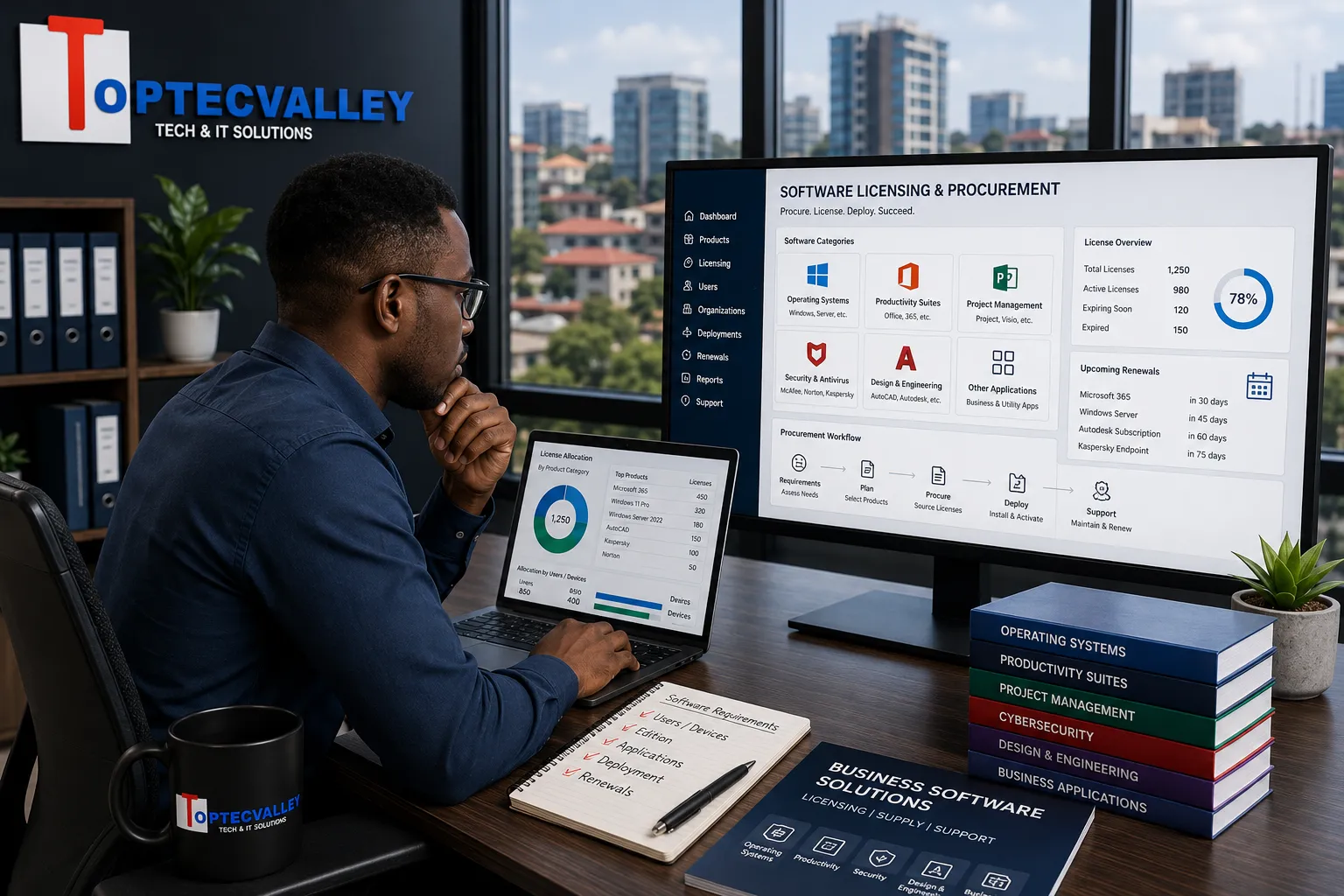
Correct Software. Appropriate Requirement.
The right supply path depends on the software product, edition, number of users or devices, licensing model, compatibility requirements, and intended business use.
Poor Software Procurement Creates Expensive Operational Problems
Buying software without first establishing the correct product, edition, number of users or devices, compatibility requirements, renewal model, and intended business use can create avoidable cost and disruption. Organizations may purchase licences that do not match their environment, underestimate actual user requirements, lose visibility of renewal dates, or discover too late that a selected application does not support the required workflow.
For businesses and organizations in Uganda, poor software procurement can affect more than the IT department. It can delay projects, interrupt employee access, complicate budgeting, create inconsistent software environments, and force teams to repeat purchasing decisions that should have been planned correctly from the beginning.
Wrong Product or Edition
A familiar product name does not guarantee the selected edition includes the features, management capabilities, compatibility, or usage model the organization actually requires.
Incorrect User or Device Quantities
Procurement based on rough estimates can leave teams under-supplied, create unnecessary purchases, or fail to account for how software access is assigned across users and devices.
Compatibility Discovered Too Late
Operating systems, hardware specifications, existing applications, file formats, integrations, and deployment environments should be considered before purchase.
Fragmented Renewal Management
Different purchase dates, subscription periods, departments, and products can create scattered renewal cycles that are difficult to forecast, budget, coordinate, and manage.
Unclear Deployment Requirements
Buying a licence is not the same as planning installation, activation, user allocation, configuration, migration, or an organization-wide software rollout.
Procurement Without Business Context
Software selected without understanding the actual workload can result in teams paying for unsuitable capabilities or lacking functions needed for daily operations.
Reactive Software Buying
- Product selected mainly by name or initial price
- User quantities estimated informally
- Compatibility checked after purchase
- Renewals handled when expiry becomes urgent
- Departments procure independently without visibility
- Deployment requirements discovered late
Requirement-Led Procurement
- Product and edition matched to intended use
- Users and devices assessed before quotation
- Compatibility considered before procurement
- Renewal requirements planned earlier
- Organizational needs consolidated where practical
- Supply and deployment responsibilities clarified
Toptecvalley approaches software supply as a requirements-led procurement process. Before a quotation becomes meaningful, the organization should understand what software is required, who will use it, where it will run, which edition is appropriate, and what happens after supply.
Software Licensing Services Uganda for Business Requirements
Software Licensing Services Uganda should begin with the organization’s actual requirements rather than a generic list of products. Toptecvalley supports businesses, institutions, NGOs, professional firms, project teams, and other organizations that need software for individual users, multiple devices, departments, technical teams, or wider operational environments.
Our role is to help clarify the required software category, product, edition, quantity, user or device scope, compatibility considerations, procurement timing, and deployment expectations before supply. This is particularly important where organizations are purchasing several licences, coordinating different software products, preparing renewals, or standardizing applications across teams.
Operating Systems & Platform Software
Support for business requirements involving desktop and server operating systems, upgrades, editions, device environments, and compatibility considerations. This can include Microsoft Windows requirements where applicable.
Productivity & Office Applications
Procurement planning for office productivity software used for documents, spreadsheets, presentations, email-related workflows, collaboration, and day-to-day business operations.
Project Management & Diagramming Tools
Software requirements for project planning, scheduling, resource coordination, process mapping, technical diagrams, organizational charts, and workflow visualization.
Cybersecurity & Antivirus Software
Endpoint security and antivirus procurement requirements for individual devices, multiple users, business environments, and renewal planning. Relevant needs may include McAfee, Norton, Kaspersky, and other suitable security products.
Design, Engineering & Technical Software
Procurement support for professional applications used in architecture, engineering, drafting, technical design, visualization, and related specialist workflows. This can include Autodesk AutoCAD requirements where applicable.
Specialist & Business Applications
Software outside the major categories, including role-specific, departmental, operational, utility, backup, PDF, remote-access, and other business applications where sourcing and requirement clarification are needed.
Need Several Software Products for One Organization?
Toptecvalley can help consolidate requirements across departments or teams before quotation. A request may involve different software categories, quantities, editions, renewal periods, and deployment expectations. Bringing those requirements together early can improve visibility and reduce fragmented purchasing decisions.
The software category is only one part of a correct procurement decision. The next step is understanding the specific products, editions, user quantities, device requirements, compatibility considerations, and licensing factors that shape a meaningful quotation.
Software Products & Vendor Requirements We Support
Organizations rarely need software from only one category. A single procurement request may involve operating systems, productivity applications, project management tools, cybersecurity products, design software, and specialist business applications for different teams.
Toptecvalley supports requirement-led sourcing for a broad range of software products used by businesses, institutions, NGOs, professional firms, technical teams, and other organizations in Uganda. Product availability, editions, licensing models, subscription periods, regional eligibility, quantities, and deployment requirements should be confirmed as part of the quotation process.
Microsoft Operating Systems & Productivity Software
Requirements may involve desktop and server operating systems, office productivity applications, collaboration tools, and related Microsoft business software for individual users, departments, or wider organizational environments.
- Windows
- Microsoft 365
- Office Applications
- Windows Server
- Business Software
Project Planning & Diagramming Software
Software requirements for project scheduling, resource planning, process mapping, technical diagrams, workflow visualization, organizational charts, and related planning activities.
- Microsoft Project
- Microsoft Visio
- Scheduling Tools
- Process Mapping
- Workflow Software
Cybersecurity & Antivirus Solutions
Security software requirements may involve individual devices, multiple endpoints, business teams, subscription renewals, operating-system coverage, and broader endpoint protection needs.
- McAfee
- Norton
- Kaspersky
- Endpoint Protection
- Multi-Device Security
Autodesk & Technical Design Software
Professional requirements may involve applications used for drafting, architecture, engineering, CAD workflows, technical documentation, visualization, and other specialist design activities.
- AutoCAD
- Autodesk Software
- CAD Applications
- Drafting Tools
- Technical Design
PDF, Utility & Business Applications
Organizations may also require software for document handling, backup, compression, remote access, departmental productivity, administration, and other practical business workflows.
- PDF Software
- Backup Applications
- Archive Utilities
- Remote Access
- Business Utilities
Specialist Software by Request
If the required application is not listed, Toptecvalley can review the request based on the exact product name, vendor, edition, version, number of users or devices, intended use, and required procurement timeframe.
- Exact Product
- Vendor
- Edition
- Version
- Users or Devices
Know the Software You Need? Send Us the Exact Requirement
A precise request helps us review the requirement more effectively. Where possible, provide the exact software name, edition or version, required quantity, user or device scope, renewal status, operating environment, and expected procurement timeframe.
Identifying the product is only the beginning. A reliable quotation also depends on quantities, editions, users, devices, compatibility, renewal status, procurement timing, and the organization’s intended deployment model.
Bulk Software Licensing for Businesses & Organizations
Software requirements become more complex when an organization is purchasing for multiple users, devices, departments, branches, projects, or technical teams. A bulk request may involve different products, editions, quantities, subscription periods, renewal dates, operating environments, and deployment responsibilities within the same organization.
Toptecvalley supports businesses, institutions, NGOs, professional firms, project teams, and other organizations in Uganda that need structured software procurement beyond a single-user purchase. The objective is to clarify the requirement before quotation so that quantities, user or device scope, product editions, timing, compatibility considerations, and deployment expectations are visible from the beginning.
Multi-User Requirements
For organizations purchasing software access for several employees, professional users, project members, administrators, or technical personnel.
Multi-Device Environments
For software requirements covering desktops, laptops, workstations, servers, or other supported organizational devices.
Departmental & Role-Based Procurement
Finance, administration, engineering, project management, design, operations, and IT teams often require different applications and capabilities.
Branch, Project & Distributed Teams
Requirements may need coordination across branches, field teams, temporary projects, remote staff, or distributed organizational environments.
Renewals & Software Estate Standardization
Existing organizations may have fragmented purchases, mixed editions, inconsistent applications, or different renewal dates across teams.
What Should Be Confirmed Before a Bulk Quotation?
A structured requirement helps separate genuine operational needs from rough quantity assumptions. The following areas provide a practical starting point for organizational software procurement.
Users
- What to confirm
- Number of users and the roles that require software access.
- Why it matters
- Prevents crude quantity assumptions and identifies role-specific application needs.
- Example scope
- 25 staff, 5 project managers
Devices
- What to confirm
- Device count, device type, operating system, and environment.
- Why it matters
- Supports compatibility planning and clarifies where software must operate.
- Example scope
- Laptops, workstations, servers
Products
- What to confirm
- Required software applications by team, role, or workflow.
- Why it matters
- Avoids one-size-fits-all procurement across departments with different responsibilities.
- Example scope
- Office, Project, Visio, security
Editions
- What to confirm
- Required features, capabilities, editions, versions, or plans.
- Why it matters
- Reduces the risk of purchasing an unsuitable edition or paying for unnecessary capability.
- Example scope
- Standard vs advanced needs
Timing
- What to confirm
- New purchase dates, renewal dates, project milestones, and rollout phases.
- Why it matters
- Improves continuity planning and distinguishes urgent, phased, and future requirements.
- Example scope
- Immediate, phased, annual
Deployment
- What to confirm
- Installation, allocation, internal IT responsibilities, and expected assistance.
- Why it matters
- Clarifies responsibilities before supply and reduces ambiguity during rollout.
- Example scope
- Internal IT or assisted rollout
Prepare Your Bulk Software Requirement for Quotation
You do not need every detail finalized before contacting us, but a clearer requirement can improve the quality of the review. Where possible, provide the organization, products, estimated quantities, current environment, renewal status, procurement timing, and expected deployment scope.
Bulk procurement becomes more reliable when requirements are documented before pricing and supply decisions are finalized. The next stage is understanding how Toptecvalley reviews a request, clarifies uncertainties, prepares the quotation scope, and coordinates the path from requirement to supply.
Our Software Procurement & Licensing Process
Buying software for a business or organization should begin with the actual requirement, not with assumptions about product names, quantities, or editions. A request that appears simple may still involve user eligibility, device coverage, operating-system compatibility, subscription terms, renewal status, regional conditions, deployment responsibilities, and procurement timing.
Toptecvalley follows a structured requirement-led process for software licensing and supply requests in Uganda. The objective is to clarify what is needed, identify uncertainties early, define the quotation scope, and coordinate the path toward supply based on the confirmed requirement and available sourcing options.
Submit the Software Requirement
The process begins with the customer’s known requirement. The request does not need to be perfect before submission; where details are missing, they can be identified during review.
- Product or software family
- Vendor name where known
- Edition or version
- Number of users or devices
- New purchase or renewal
- Required timeframe
Requirement Review & Clarification
Toptecvalley reviews the request to identify missing or ambiguous information that could affect quotation, suitability, quantity, or the intended deployment scope.
- User versus device scope
- Product edition
- Existing software environment
- Renewal status
- Subscription period
- Departmental or role differences
Compatibility & Scope Check
Before quotation scope is finalized, relevant technical and operational factors are considered where applicable to the requested product and intended environment.
- Supported operating systems
- Device or workstation capability
- Existing environment
- Application dependencies
- Version compatibility
- User roles and deployment model
Sourcing & Quotation Preparation
Once the requirement is sufficiently clear, sourcing and quotation preparation can proceed based on the confirmed scope and available options.
- Exact product and edition
- Quantity
- Subscription term
- New purchase or renewal
- Availability and applicable conditions
- Delivery and agreed support scope
Customer Confirmation & Supply Coordination
After quotation review, confirmed requirements move into supply coordination according to the agreed scope and applicable conditions.
- Quotation acceptance
- Final quantity confirmation
- Billing details
- Procurement coordination
- Delivery or recipient information
- Agreed support responsibilities
Delivery, Deployment Guidance & Renewal Visibility
The final stage depends on the product and the agreed service scope. Handover and follow-up activities vary according to the confirmed requirement.
- Delivery coordination
- Licence or subscription information
- Installation guidance where agreed
- Deployment coordination where agreed
- Basic handover information
- Renewal-date visibility where applicable
What Can Affect Software Pricing, Availability & Delivery?
Software procurement is not identical across every product or vendor. Pricing and supply conditions may be affected by the exact edition, quantity, user or device model, subscription period, renewal status, regional eligibility, vendor conditions, current availability, currency movement, procurement timing, and required support scope.
Have a Software Requirement Ready for Review?
Send Toptecvalley the product name, edition or version where known, estimated users or devices, purchase or renewal status, current operating environment, and required timeframe. If some details are unclear, submit what you already know and identify the areas that still need clarification.
A structured procurement process helps reduce avoidable assumptions, but organizations still need confidence in the supplier handling their requirement. The next section explains the practical reasons businesses and institutions choose Toptecvalley for software licensing and supply support in Uganda.
Why Choose Toptecvalley for Software Licensing in Uganda?
Software procurement decisions can affect budgets, user productivity, compatibility, renewals, deployment planning, and long-term technology management. Choosing a supplier should therefore involve more than comparing a product name against a price.
Toptecvalley supports businesses and organizations in Uganda with a requirement-led approach to software licensing and supply. We help customers define what they need, clarify procurement scope, coordinate suitable sourcing options, and connect software requirements with the wider IT environment where relevant.
We Start With the Actual Requirement
A customer may know the software family they need without knowing the exact edition, licensing model, user scope, device scope, or renewal path. Toptecvalley begins by reviewing the known requirement and identifying information that may still need clarification before quotation.
- Fewer avoidable assumptions
- Clearer quotation scope
- Better quantity definition
- Improved procurement planning
One Procurement Conversation Across Multiple Software Needs
Organizations may need operating systems, productivity software, project and diagramming tools, endpoint security, design applications, or other specialist business software. Toptecvalley can review multi-product requirements rather than forcing every request into a single software category.
Built Around Organizational Requirements
Business software procurement often involves more than a single user making a one-off purchase. Requirements may involve departments, shared standards, multiple devices, phased deployment, renewal planning, internal approvals, quotation documentation, or defined procurement timeframes.
- SMEs and growing companies
- Corporate offices
- NGOs and development organizations
- Schools and training institutions
- Professional firms
- Multi-user departments
Software Decisions Consider the Technology Around Them
A software requirement may interact with operating systems, workstation specifications, user accounts, network access, cloud services, security controls, existing applications, or deployment responsibilities. Where relevant to the agreed scope, Toptecvalley can consider these surrounding factors during requirement clarification.
- Better compatibility awareness
- Clearer deployment expectations
- Better connection to IT operations
- More informed requirement discussions
A Uganda-Based Point of Contact
Organizations often need a practical communication channel for requirement clarification, quotation discussions, procurement coordination, and follow-up. Toptecvalley provides a local point of contact for customers handling software requirements in Uganda.
We Avoid Treating Every Software Request as Identical
Product editions, quantities, subscription periods, renewal status, user or device models, regional conditions, availability, procurement timing, and support requirements can affect the final scope. Toptecvalley’s approach is to clarify relevant variables rather than imply that every request has one universal price or delivery path.
- Better expectation setting
- More transparent quotation discussions
- Clearer supply and support boundaries
- Reduced ambiguity around scope
Who Is This Service Designed For?
Toptecvalley’s software licensing and procurement support is suited to organizations that need a more structured approach than simply purchasing an unidentified product key or selecting software without reviewing the wider requirement.
Businesses & SMEs
For companies purchasing software for staff, departments, workstations, or operational growth.
Corporate Offices
For structured user, device, productivity, security, and renewal requirements across business teams.
NGOs & Development Organizations
For teams needing defined procurement scope, multi-user requirements, project software, or coordinated planning.
Schools & Training Institutions
For administrative, productivity, security, design, and computer-lab software requirements, subject to applicable product conditions.
Professional Firms
For engineering, architecture, consulting, accounting, legal, project, and other specialist working environments.
Project & Technical Teams
For defined software requirements linked to projects, specialist applications, user groups, or deployment timeframes.
What We Will Not Assume
We will not assume that the most familiar product name is automatically the correct edition, that every user needs the same software, that every device is compatible, that all products follow identical licensing conditions, or that every request has the same delivery path.
Need a Software Supplier Who Will Review the Requirement First?
Share the software product or family you are considering, the estimated number of users or devices, whether the requirement is new or a renewal, and your expected timeframe. Toptecvalley can use that information as the starting point for requirement clarification and procurement discussion.
Choosing a software supplier is one part of the decision. Customers also need clear answers about licensing scope, renewals, installation expectations, availability, delivery, and support responsibilities. The next section addresses common questions about software licensing and procurement in Uganda.
Frequently Asked Questions About Software Licensing in Uganda
Buying software for a business or organization can involve questions about editions, subscriptions, renewals, users, devices, compatibility, installation, availability, and procurement scope. The answers below address common questions customers may have when discussing software licensing and supply with Toptecvalley in Uganda.
Exact conditions can vary by software product, publisher, licensing model, quantity, region, subscription term, and confirmed requirement. Where a request depends on product-specific rules, Toptecvalley should clarify the applicable scope before quotation or supply.
Products & Procurement
What types of software can Toptecvalley help businesses procure?
Toptecvalley can discuss requirements involving operating systems, productivity suites, project and diagramming tools, endpoint security products, design and engineering applications, and other specialist business software. Examples may include Windows, Microsoft 365 and Office, Microsoft Project, Microsoft Visio, Autodesk AutoCAD, McAfee, Norton, Kaspersky, and other products depending on the confirmed requirement and availability.
Do you supply software licenses in bulk for businesses and organizations?
Yes. Toptecvalley can review multi-user, multi-device, departmental, or organization-wide software requirements. The appropriate procurement scope may depend on the number of users or devices, required product edition, licensing model, subscription period, deployment environment, renewal status, and applicable product conditions.
Can I request a quotation before purchasing software?
Yes. Customers can submit the software product or family they are considering, estimated quantity, number of users or devices, whether the requirement is new or a renewal, and the expected procurement timeframe. Where necessary, Toptecvalley may request additional information before preparing or confirming a quotation.
What information should I provide when requesting software licenses?
Useful information includes the software name or intended business purpose, estimated number of users or devices, preferred edition if already known, current operating environment, whether the request is new or a renewal, expected timeframe, and any installation or deployment support requirements. If some details are unknown, the discussion can begin with the information already available.
Can Toptecvalley help if I do not know the correct software edition?
Toptecvalley can help clarify the requirement by reviewing factors such as intended use, users, devices, existing systems, required capabilities, and known procurement constraints. Final suitability can still depend on publisher-specific product terms, technical requirements, and the confirmed scope.
Renewals & Product Requirements
Do you support software renewals as well as new requirements?
Renewal requirements can be discussed alongside new software procurement. Customers should provide available information about the existing product, edition, subscription or license arrangement, renewal timing, quantity, and any planned changes. Renewal options depend on the specific product and applicable conditions.
Can you help with Microsoft software requirements?
Toptecvalley can discuss customer requirements involving products such as Windows, Microsoft 365, Office, Project, and Visio. The correct scope may depend on product edition, user or device requirements, subscription or other applicable licensing arrangements, quantity, compatibility, and availability.
Can you help with Autodesk AutoCAD and other specialist software?
Toptecvalley can review requirements involving AutoCAD and other specialist business, technical, design, or professional software. The discussion should establish the required product, intended users, quantity, operating environment, timeframe, and other relevant procurement details before quotation or supply.
Do you supply antivirus and endpoint security software?
Toptecvalley can discuss requirements involving antivirus and endpoint security products, including software families from providers such as McAfee, Norton, Kaspersky, and others. Suitability may depend on device count, operating environment, required security capabilities, subscription term, centralized management needs, and product availability.
Delivery, Compatibility & Support
Is installation included when I purchase software?
Installation or deployment support should not be assumed to be automatically included with every software supply. The scope can vary by product and customer requirement. Where installation, configuration, migration, deployment, or other technical assistance is needed, that requirement should be discussed and defined separately or as part of the agreed scope.
How quickly can software be supplied?
Delivery timing can vary according to the product, edition, quantity, sourcing route, publisher or distributor conditions, availability, payment confirmation, and any requirement clarification still outstanding. Toptecvalley should confirm the expected path for the specific request rather than applying one universal delivery promise to every software product.
Can Toptecvalley guarantee that software will work on my existing computers?
Compatibility should be reviewed rather than assumed. Relevant factors can include operating system version, hardware specifications, architecture, existing applications, network environment, account requirements, and publisher-defined system requirements. Where compatibility is a concern, customers should raise it before procurement.
Do you provide support after software supply?
Post-supply assistance depends on the agreed scope, software product, procurement arrangement, and any separately defined support services. Customers should clarify expected responsibilities for installation, activation assistance, configuration, troubleshooting, deployment, or ongoing technical support before purchase.
Organizations & Next Steps
Can schools, NGOs, SMEs, and corporate organizations request software quotations?
Yes. Toptecvalley can discuss software requirements from businesses, SMEs, corporate offices, NGOs, schools, training institutions, professional firms, project teams, and other organizations. Product-specific eligibility, terms, pricing structures, or institutional programs should never be assumed and may require separate confirmation.
How do I request software licensing support from Toptecvalley?
Send the known requirement through the Toptecvalley contact page or WhatsApp. Include the software name or intended use, estimated users or devices, whether the request is new or a renewal, and the expected timeframe. Toptecvalley can then identify any additional information needed for the next step.
Request a Software Licensing Quote in Uganda
Need software licenses for your business, organization, institution, or project team? Share your requirement with Toptecvalley and provide the information you already know. We can review the request, identify any details that still need clarification, and discuss the appropriate next step for quotation and procurement.
Whether you are considering operating systems, productivity software, project and diagramming tools, endpoint security products, design applications, renewals, or other specialist business software, the strongest starting point is a clearly defined requirement.
Tell Us What Software You Need
You do not need to have every licensing detail confirmed before contacting us. Send the information currently available, and we can identify what may still need clarification.
We review the information provided, identify any missing requirement details, and determine the appropriate next step for quotation, availability discussion, or further clarification.
What to Include in Your Request
You can still contact us if some information is unknown. However, including the details below can reduce avoidable back-and-forth and make the requirement easier to assess.
-
01
Software Name or Intended Purpose
Tell us the product you are considering or the business task you need the software to support.
-
02
Number of Users or Devices
Provide an estimate if the exact quantity is not yet confirmed.
-
03
New Purchase or Renewal
Indicate whether this is a new requirement, expansion, replacement, or renewal.
-
04
Known Edition or Version
Include the preferred edition if already identified. If unknown, state that clearly.
-
05
Current Operating Environment
Mention relevant operating systems, computers, existing software, or technical constraints where known.
-
06
Expected Procurement Timeframe
Tell us whether the requirement is immediate, planned for a specific project, or tied to a renewal date.
-
07
Installation or Deployment Needs
State whether you also need installation, configuration, migration, deployment, or related technical assistance.
“We need Microsoft productivity software for approximately 25 users. This is a new requirement for our office in Uganda. We would like guidance on the appropriate option and a quotation.”
Requirements May Include
Product references below indicate examples of customer requirements that may be discussed. They do not imply universal availability, identical licensing conditions, or an official partnership status.
Start With the Requirement, Not Assumptions
Clear requirements lead to better procurement decisions. Toptecvalley reviews software requests based on the information provided, applicable product conditions, availability, compatibility considerations, quantities, and the confirmed scope. Where additional clarification is required, that should happen before final quotation or supply.
Software procurement should begin with the requirement—not assumptions. Share what you know, and Toptecvalley can help define the next practical step.